Esperienze in Africa, passate e presenti, per farle conoscere a tutti, amici e appassionati del Continente Nero che non è più la terra degli esotismi e dell'avventura ma è una area del mondo che pone con forza i suoi diritti e guarda all'Occidente più progredito.
Experiences in Africa to share with friends and lovers of the Dark Continent, that is no longer the Continent of exoticism and adventure, but it is an area of the world that wants to affirm its rights.
Visualizzazione post con etichetta Etiopia-Ethiopie-Ethiopia. Mostra tutti i post
Visualizzazione post con etichetta Etiopia-Ethiopie-Ethiopia. Mostra tutti i post
Beraki Gebre (diminutivo del suo nome) nella sua cameretta presso la casa di riposo.
Beraki Gebre (diminutif de son nom) dans sa petite chambre de la maison de repos.
La voce di Gebre si affievolisce mentre parla. Racconta della sua vita, quella passata a a fianco degli Italiani in Etiopia, fino alla caduta di Gondar. Non si ricorda della battaglia di Culqualber.
Tra qualche giorno è il suo compleanno essendo nato a Adinebri, Etiopia il 15 aprile del 1914.
Gli ha fatto immensamente piacere la mia visita ed ancor di più i miei racconti sull'Etiopia e sull'Eritrea. Credo che se qualcuno ha un pò di tempo per rendere visita al Vecchio Ascaro, sarà cosa molto gradita. Alloggia presso la Residenza Parco di Veio a Via Rocco Santoliquido , Roma, alla Giustiniana, sulla Via Cassia. A presto Gebre.
La voix de Gebre faiblit pendant qu’il parle. Il raconte sa vie passée aux côtés des Italiens en Éthiopie, jusqu’à la chute de Gondar. Il ne se rappelle pas de la bataille de Culqualber. Dans quelques jours, c’est son anniversaire : il est né à Adinebri en Ethiopie le 15 avril 1914. Ma visite lui a fait énormément plaisir et plus encore mes histoires sur l’Ethiopie et sur l’Erythrée. Je pense que si quelqu’un a un peu de temps pour rendre visite au vieux Ascaro, ce sera très apprécié. Il habite dans la Résidence Parco di Veio sur Via Rocco Santoliquido, à Rome, dans le quartier de la Giustiniana, dans les environs de la via Cassia. A bientôt Gebre.
Vista della stele, finalmente rimontata da una Ditta italiana in un luogo idoneo scelto da archeologi italiani. Tutto il macchinario necessario è stato trasportato dall'Italia, comprese le impalcature in tubi "Innocenti" forse mai viste in Etiopia. Chissà se un giorno si saprà il costo totale dell'intera operazione. Tra le righe dei vari articoli sui giornali appaiono cifre come 10.000.000,00 di euro. Forse qualcuno dirà che per questo tipo di interventi non si deve guardare ai costi...ma vi prego, raccontatelo pure al popolo Etiope, che lotta giornalmente contro la fame, la sete e le malattie.
*******
Vue de l'obélisque, finalement remise sur pieds par une société italienne dans un lieu adéquat choisi par des archéologues italiens. Tout l'équipement nécessaire a été transporté par l'Italie, y compris les échafaudages en tubes "Innocenti" sans doute jamais utilisés en Éthiopie auparavant. Qui sait si un jour on connaîtra le coût total de l'opération. Entre les lignes, dans des articles de différents journaux, apparaissent des chiffres comme 10.000.000,00 €. Certains diront peut-être que pour ce type d'opération, il ne faut pas tenir compte des coûts... mais s'il vous plaît, racontez-le au peuple éthiopien, qui lutte quotidiennement contre la faim.
*******
View of the stele, finally hoisted up by an Italian company in a site chosen by Italian archeologists. All the necessary machinery was transported from Italy, including the scaffonding in steel, perhaps never seen in Ethiopia. Who knows if one day anyone will know the total cost of the entire operation? Between the lines of various newspaper articles appear figures like 10 million Euros. Maybe someone might say that for this find of operation one shouldn't mind the cost...but please, go tell this to the Ethiopians who fight daily agaist famine.
*******
Ai primi di settembre, tutta l'Etiopia è stata mobilitata per la cerimonia dell'innalzamento della famosa stele Axum che fu "rubata" dalle truppe di Mussolini circa 70 anni fa. La stele giaceva a terra rotta in più pezzi. Finalmente più che il popolo etiope, che ha ben altre priorità a cui pensare, gioiscono l'Unesco, la Unione Africana, (la vecchia OUA) che a sede ad Addis Abeba.
Perchè la Francia non restituisce tutto ciò che Napoleone ha "preso" in Egitto?
E perchè la tanto attiva Unione Africana contro l'Italia non agisce per la fine della dominazione spagnola di Ceuta e Melilla?
******
Début septembre, toute l'Ethiopie a été mobilisée pour la cérémonie d'inauguration de l'obélisque de Axum remis sur pieds et qui fut "volée" à l'Ethiopie par les troupes de Mussolini il y a 70 ans. L'obélisque gisait par terre, brisée. Finalement plus que le peuple éthiopiens, ce sont l'UNESCO et l'Union Africaine, qui a son siège à Addis Abeba (la vieille OUA) qui s'en réjouissent.
*******
The first days of September, allof Ethiopia was mobilized for the hoisting of the famous Axum stele that was "stolen" by Mussolini's troops about 70 years ago. The stele was broken in several places on the ground. Finally, more than Ethiopian people, who have other priorities to think about, the Unesco and the African Union ( ex OUA) with its main office in Addis Abeba, were overjoyed.
Durante la mia permanenza a Macallé, si presentò a casa un anziano signore etiope. Aveva in mano una lettera scritta in un inglese, alquanto difficile da comprendere. Chiedeva aiuto a dei suoi connazionali, poiché Michele è figlio del Signor Mario di Napoli che durante l'occupazione dell'Etiopia era al seguito delle truppe italiane. Trovò Macallé accogliente e vi aprì un ristorante chiamato "Angolino" nella Piazza Hawsien. Si sposò con una signora etiope e nacque Michele. Nel 1941, con l' arrivo degli Inglesi, Mario fuggì lasciando la famiglia ed il ristorante. Aveva comperato terreni e case che lasciò a sua moglie. Non si sentì più parlare di lui e neanche si fece più vivo a Macallé. Michele e sua mamma vivevano discretamente fino al giorno che Menghistu non confiscò loro ogni avere. La casa, dove oggi sorge la sede centrale della Commercial Bank di Macallé, fù bruciata dai soldati del dittatore poiché la mamma di Michele non voleva andarsene con le buone maniere. E con la casa bruciarono anche i documenti cartacei che ricordavano il breve passaggio di Mario il Napoletano in Etiopia di cui nessuno nè conosce il cognome. Michele ha sempre lavorato in un mulino. Ha respirato per tutta la sua vita la malsana polvere dei cereali. E' ammalato ai polmoni. Ha una famiglia da mantenere ed una graziosa bimba di 10 anni che va a scuola, per fortuna. La moglie è deceduta qualche anno fà. Non riceve alcuna pensione ne aiuto alcuno. Vive in una misera capanna senza elettricità, né acqua e servizi. Ho fatto per loro quello che ho potuto. Ancora ricordo il suo sguardo triste quasi da cane bastonato. Tramite lui ho avuto la fortuna di incontrare Kansay che era amico di suo padre.
Trovai Kansay nella sua casa, disteso sul letto. Non ha più la forza per alzarsi. E' ammalato di diabete. L'estremità dei suoi piedi stanno andando alla malora. E' magro Kansay, quasi novantenne, ma il suo viso si è riempito di gioia quando ci siamo messi a parlare in italiano. Mi ha raccontato la sua vita con i soldati ed i civili Italiani. I suoi occhi erano lucidi e più di una volta ha passato un strausato fazzoletto per asciugarsi qualche lacrima. Parlando, il suo italiano diventava più spedito ed i ricordi si facevano più vicini. 50 lire ebbe di premio dal preside della scuola italiana di Macallé per la sua bravura. I pomeriggi passati con Mario al ristorante "Angolino". Quando poteva andava a curiosare presso l'unico ospedale italiano civile di Macallè dove il Dr. Musso gli passava la mano sui suoi capelli crespi. Gli chiesi se sapeva qualcosa a proposito dell'avvelenamento del lago Ashanghi (verso sud, non troppo lontano da Macallé) da parte delle truppe italiane in fuga. Risposta negativa, non aveva mai sentito parlare di questo "avvelenamento" (tanto in voga presso alcuni gruppi non più presenti a Macallé). Ricordi, tanti meravigliosi ricordi raccontati con passione. Mai una parola di astio, anzi al contrario. Vennero tempi duri per gli Italiani. Kansay si trovava a Quihà, presso l' ospedale militare italiano al momento della ritirata delle truppe di Mussolini. I militari dicevano agli Etiopici di prendere qualsiasi cosa, poiché tra poco sarebbero arrivati gli Inglesi i quali avrebbero rastrellato tutto, anche i chiodi. Kansay domandò il permesso di portarsi via un letto per sua madre. Si presentò a casa sotto il peso di un letto metallico bianco dono dei militari italiani in fuga. Mi ha detto che ancora questo letto esiste da qualche parte. Povero Kansay, memoria vivente, senza rancore alcuno. Chissà se lo rivedrò ancora.
During my stay in Macallé, an old Ethiopian man came to my house. He had a letter written in English and very difficult to understand. It asked for help for his countrymen, since Michele is the son of Mr. Mario from Naples who during the occupation in Ethiopia was part of the Italian troops. He thought Macallé was inviting and he opened a restaurant called " Angolino" in Hawsien Square. He married an Ethiopian woman and Michele was born. In 1941, upon the arrival of the English, Mario fled, leaving behind the family and the restaurant. He had bought land and houses that he left to his wife. No one ever heard from him or did he ever show up again in Macallé. Michele and his mother lived fairly well until the day that Menghtsu confiscated all their possessions. THe house, where the Commercial Bank of Macallé now stands, was burned by soldiers of the dictator since Michele's mother did not want to leave without a battle. And with the house, all the paper documents burned that were reminders of the short time that Mario, the Neopolitan was in Ethiopia: nobody even knew his surname. Michele had always worked in a mill. He has always breathed the unhealthy grainy dust. His lungs are sick. He has a family to maintain and a sweet little 10 year old girl who fortunately goes to school. His wife died a few years ago. He doesn't receive a pension or any financial assistance. He lives is a poor hut without any electricity, water or a sanitary structure. I did what I could for them. I still recall his sad expression, almost like a beaten dog. Though him, I had the fortune to meet Kansay who was a friend of his father. I found Kansay in his house, lying in his bed. He does not have the energy to get up and suffers from diabetes. The extremities of his feet are deteriorating. Kansay is very thain, almost ninity years old, but his face lit up when we started to speak Italian. He told me the story of his life with the Italian soldiers and civilians. His eyes were shiny and more than once he dried his eyes with an old used handkerchief. His Italian became better by talking and his memories became more vivid. He recevied 50 Lire as a prize from the principal of the Italian school in Macallé for his skills. He remembered the afternoons spent with Mario in the " Angolino" restaurant. When he could, he would go to the only Italian civil hospital of Macallé where Dr. Mussop would pat his head of curly hair. I asked him if knew anything about the poisoning of AShanghi Lake ( toward the South, not far from Macallé) by the fleeing Italian troops. He said he knew nothing about this "poisoning" (very in vogue by some groups that were no longer in Macallé). Memories, a lot of wonderful memories recounted passionately. Never a mean word, quite the contrary. When the difficult times came for the Italians, Kansay was in Quihà at the Italian military hospital when Mussolini's troops withdrew. The military told the Ethiopians to take whatever they could, since the English would be arriving soon and would have taken evething, down to the last nail. Kansay asked permission to take a bed for his mother. He went back home with a heavy white metallic bed donated by the fleeing Italian military. He told me that this bed is still around somewhere. Poor Kansay, a living memory, without hard feelings. Who knows if I'll ever see him again?
Paletti Angelo Vittorio, di Antonio. Caporale Maggiore di Artiglieria, nato il 1911 a Mairano (BS), deceduto in combattimento il 28 febbraio 1936 a Debra Amba . Medaglia di bronzo. Capopezzo di una sezione da 65/17 mentre si portava avanti in zona battuta e scoperta per la scelta della postazione cadeva colpito a morte.
La lapide dell'Alpino Cancian Agostino da Susegana (TV), caduto a Uork Amba il 27.02.1936 all'ospedale 215 a Passo Uarieu, per ferite in combattimento.
Il Monte Work Amba (Uorc Amba) come è oggi.
Il Monte Work Amba (Uorc Amba) nel 1936. (Foto proveniente dall'archivio del Soldato Tribboli Bruno).
Bassorilievo in terracotta, donato dal P. Del Grande che raffigura Padre Reginaldo Giuliani che conforta un morente. Morì durante lo scontro di Mai Beles.
...padre Giuliani fu visto ad un tratto afferrare la salma del capomanipolo medico Chiavellati per sottrarlo al furore di alcuni abissini che tentavano di spogliarlo e mutilare il corpo dell'ufficiale. Giuliani, già ferito, si trascinava a fatica. Con la mano sinistra si appoggiava a terra, mentre con la destra teneva alto il crocifisso. Un gruppo di Amhara gli si avventò addosso, e un colpo di guradé gli asportò quasi di netto la clavicola, uccidendolo...(dal libro: "Passo Uarieu" di Pierluigi Romeo di Colloredo).
Bas-relief en terre cuite, offert par P. Del Grande qui représente Père Reginaldo Giuliani entrain de réconforter un mourant.
Bas-relief terracotta, donated by P. Del Grande which depicts Father Reginaldo Giuliani who comforted a dying person. He died during the battle of Mai Beles.
......Padre Giuliani was suddenly seen grabbing the body of the head doctor Chiavellati to take him away from the Abyssinians who were trying to undress him and mutilate the body. Giuliani, who was already wounded, dragged himself. With his left hand, he leaned on the ground, while holding the crucifix high with his right hand. A group of Amhara attacked him and hit him with a gurade’ which tore apart his shoulder, killing him…(from the book: Passo Uarieu by Pierluigi Romeo di Colloredo).
Barbarino Pasquale, di Pietro. Camicia Nera della M.V.S.N., nato il 1898 Arienzo San Felice (CE), deceduto il 21.01.1936 a Passo Uarieu, in combattimento.
Costa Annibale, fu Pietro, sottotenente degli Alpini, nato il 1911 a S. Stefano Belbo, Cuneo, caduto il 27.02.1936 a Uorc Amb, in combattimento. Medaglia d'argento. "In zona impervia guidava risolutamente per un canalone il suo plotone alla conquista di una importante posizione nemica. Mentre raggiungeva il ciglio fortemente presidiato dall'avversario ed arditamente si slanciava sui nemici, rimaneva colpito a morte il 27 febbraio 1936".
Vecchia foto della tomba del sottotente Costa Annibale.
Dr. Maglioni Armando, veterinario centurione, Passo Uarieu il 21.01. 1936. Ucciso durante lo scontro sul Mai Beles. Malgrado le sue funzioni non lo prevedessero, aveva chiesto di partecipare al combattimento anziché "imboscarsi", e si batté a colpi di moschetto come un semplice legionario. Venne ferito al ventre da un colpo di lancia, continuò a battersi finché fu finito da un secondo colpo mortale.
(dal libro: "Passo Uarieu" di Pierluigi Romeo da Colloredo, 2008, Associazione Culturale ITALIA).
********
Dr. Maglioni Armando, veterinarian centurion, Passo Uarieu 21.01.1936. Killed during the battle on Mai Beles. Although his duties did not foresee battle, he fought with his musket like a simple legionnaire. He was wounded by a spear, but continued to fight until a second deadly slash killed him. (from the book: "Passo Uarieu" of Pierluigi Romeo da Collaredo, 2008, Cultural Association ITALIA).
Quinto Giuseppe, di Leonardo. Vice Capo Squadra della M.V.S.N., nato il 1910 a Pisticci Matera, deceduto il 21.01.1936 a Mai Beles,in combattimento.
L'angolo delle CC.NN, salme ignote. L'angle de CC.NN, dépouilles inconnues. The angle of CC.NN. remains unknown.
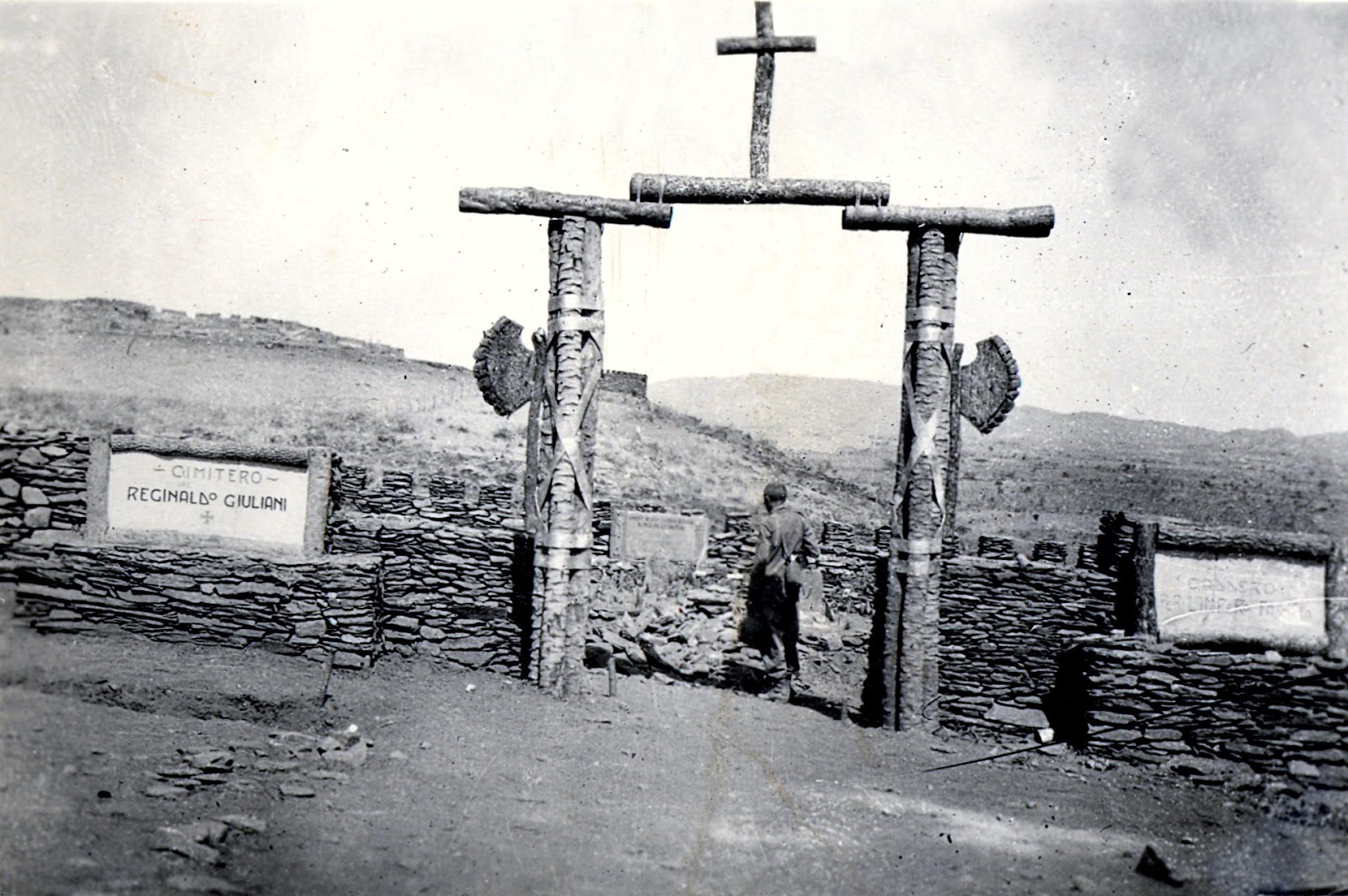
L'ingresso del cimitero di Work Amba, vicino Abbi Addi. L'entrée du cimetière de W0rk Amba, à côté de Abbi Addi. The entrance to the Work Amba war cemetery, near Abbi Addi.
Vecchia fotodell'ingresso come era all'epoca del Cimitero.
Non avevo dubbi. Le donne ed i bambini ( gli uomini sono introvabili di domenica pomeriggio, vanno nei locali a bere la tellah o tej, una bevanda locale leggermente alcolica), hanno fatto un ottimo lavoro. Tutte le erbacce sono state tagliate. Finalmente le lapidi sono leggibili. Il cimitero ha ritrovato un aspetto decente. La grande euforbia all'angolo nord era tutta in fiore. Ho iniziato a tagliare, con la sega, i piccoli alberelli dentro il cimitero stesso che crescono rovinando il cemento che ricopre le tombe. Riverniciato il cancello. Alcune lapidi spezzate sono state ricomposte e fissate al muro di cinta. Ed infine l'albero per la bandiera è stato fissato nel terreno ed una bandiera italiana nuova, ricevuta dall'Ambasciata Italiana di Addis Abeba, sventola al vento caldo di un pomeriggio afoso nel Tigray.
Il cimitero, dedicato a Padre Giuliani, raccoglie le salme di Soldati, Camicie Nere, Carabinieri, e di Padre Reginaldo Giuliani (credo che i resti di P. Giuliani siano in una chiesa di Torino), caduti durante la 1° e 2° battaglia del Tembien nella vallate del fiume Mai Beles, a Passo Uarieu o ai roccioni di Scimarbò, Debra Amba, Abbi Addi e a Work Amba (in italiano detto Uorc Amba). Qui si sono scontrati a più riprese, le truppe al comando dei Ras Kassa e Seium, con quelle al comando del Gen. Somma.
In una di queste furiose battaglie, trovò la morte il Padre Reginaldo Giuliani il 21 gennaio 1936. Così il medico Alberto Lixia descrive il ritrovamento della salma di padre Giuliani: ho ritrovato la sua salma sul campo di battaglia il mattino del 24 gennaio, ha ancora indosso la camicia nera bagnata dal suo sangue generoso. La clavicola sinistra è nettamente spezzata. La sciabolata gli è stata vibrata proprio sulla spalla sinistra dove sulla tasca della sahariana è visibilissima la croce rossa, segno distintivo dei cappellani (cit. Del Boca, 1992, p. 525).
Je n'avais aucun doute. Les femmes et les enfants (les hommes sont introuvables le dimanche après-midi, ils vont dans des buvettes et boivent de la tella, une boisson locale légèrement alcoolisée), ont fait un excellent travail. Toutes les mauvaises herbes ont été arrachées. Les pierres tombales sont finalement lisibles. Le cimetière a retrouvé un aspect décent. Le grand arbre à l'angle Nord était en fleur. J'ai commencé à couper, avec la scie, les petits arbustes qui poussent en détruisant le ciment qui recouvre les tombes. J'ai soigneusement repeint la porte en fer. Certaines pierres tombales, brisées ont été recomposées et fixées au mur d'enceinte. Enfin, le mat pour le drapeau a été fixé dans le terrain et un drapeau italien, reçu par l' Ambassade Italienne de Addis Abeba, vole au vent chaud d'un après-midi d'été au Tigray.
******
I had no doubt. The women and children (the men cannot be found during Sunday afternoons since they go to drink tella or tej, a local slightly alcoholic drink) did a great job. All the weeds were cut. Finally the tombstones are legible. The cemetery looked decent once again. The big euphorbia in the northern corner was in bloom. I started to cut, with a saw, the small branches inside the cemetery that grew ruining the cement that covered the tombs. I also painted the gate. Some broken tombstones were repaired and fixed to the wall. And finally the flag post was planted into the ground and a new Italian flag, received from the Italian Embassy in Addis Abeba, blew in the warm wind during one hot afternoon on the Tigray. The cemetery, dedicated to Father Giuliani, houses the remains of Soldiers, Black Shirts, Carabinieri and those of Father Reginaldo Giuliani (I believe the remains of P. Giuliani are in a church in Turin, Italy, fallen during the 1st and 2nd battle of Tembien in the valleys of the Mai Beles river, in Passo Uarieu or on the rocks of Scimarbo’, Debra Amba, Abbi Addi and Work Amba. This was where on several occasions the troops commanded by the Ras Kassa and Seium fought against those commanded by Gen. Somma. During one of these furious battles, Father Reginaldo Giuliani died on January 21, 1936.
This is how Dr. Alberto Lixia describes finding Father Giuliani’s body: I found his body on the battlefield on the morning of January 24, he still wears his black shirt soaked with his generous blood. The left shoulder is decidedly broken. The sword vibrated on his left shoulder where on the pocket of his safari jacket peeks the red cross, the distinctive sign of the chaplains.
Ragazza Afar. Trés jolie fille Afar.Very nice Afar girl.
In vendita qualche metro di corda, fatta a mano, per pochi Birr, cioè per 50 cents di euro. Some meters of hand-made rope for sale, for a few Birr ( 0,50 euro cents)
Le donne Afar portano anelli e braccialetti solo nella mano e nel braccio sinistro. Les femmes Afar ne portent anneaux et bracelets que sur la main et le bras gauches. The Afar women wear rings and bracelets only on their left hands and arms.
Ragazza Afar. Une fille Afar.Afar girl.
Un pastore Afar conduce i suoi dromedari per venderli al mercato.
Un berger Afar conduit ses dromadaires pour les vendre au marché. An Afar shepherd brings the own dromadary to the market.
La bandiera Afar. Le drapeau Afar.The Afar flag.
Il villaggio di Ab-ala. Le village de Ab-ala.Ab-ala village.
C'é una grande moschea a Ab-Ala uno dei più importanti centri abitati che si incontrano verso i territori ad est di Macallé. Nel villaggio convivono in apparente tranquillità Afar e Tigrigni, islamici e cristiani. In questo periodo a Macallé si sta benissimo, un tiepido sole ci tiene compagnia durante il giorno mentre la notte la temperatura scende e si dorme benissimo con la coperta; al contrario a Ab-Ala durante il giorno il sole picchia, siamo molto più bassi come quota e ci si avvicina alla depressione dancala. Il giovedì si svolge un importante mercato dove arrivano Afar anche da lontano per vendere i loro prodotti. Le donne si occupano della vendita del burro, sia per i capelli che per uso alimentare, corde vegetali, stuoie. Gli uomini Afar invece, mettono in vendita il loro bestiame: dromedari, capre e pecore. Mi volevano vendere un enorme dromedario dal pelo lucente e liscio, bella bestia davvero, a quattromila birr. Ho spiegato loro che tra poco sarei ritornato in Italia in "aeroplano" (anche in lingua amarica/tigrigna) e che la bestia é troppo grande per entrarci; questa spiegazione é stata sufficiente per smettere nelle loro insistenze.
Pare che sia vietato agli Afar di frequentare il mercato armati di kalashnikof e ghilé (jilé) e ai Tigrigni senza armi da fuoco i loro bastoni. Infatti il primo giovedì, giorno di mercato, erano tutti "disarmati". Al contrario durante la mia seconda visita erano tutti armati fino ai denti: pistole, mitra, ghilè di tutte le dimensioni (pugnali ricurvi), bastoni, poiché mancava il controllo della Polizia.
Avevo scattato molte foto nella mia precedente visita a donne Afar con le loro collane multicolori. Alcune le ho fatte stampare e alla mia seconda visita ho donato loro le foto. Hanno avuto un successone: desideravano tutte essere fotografate.
Nel mercato erano in vendita coperte nere di grandi dimensioni tessute con lana di pecora. Servono alle donne Afar per fare un "bagno di fumo". Hanno cercato di spiegarmelo ma sinceramente ho capito poco. Pare che accendono, dentro le loro tipiche capanne, un fuoco con un tipo di legna che produce tanto fumo. Ma non soffocano? E i loro occhi come fanno a resistere al fumo? Mi hanno promesso di farmi vedere a Macallé come funziona il "bagno di fumo" che serve per rendere liscia la pelle, tanto in voga tra le donne Afar e presso le donne tigrigne che possono permetterselo in città...
***************
There is a big mosque in Ab-ala, one of the most important towns toward the territories East of Macallé. In the village, in apparent tranquility, live Afars and Tigrins, Islamics and Christians. During this period in Macallé it is very nice and warm sun keeps us company during the days while during the night the temperature goes down and sleeping with a blanket is perfect: contrary to Ab-Ala, during the day the sun is hot, we are not quite so high but close to the Dancalia Depression. On Thursdays there is an important market where the AFar unite from far away to sell their products. The women sell butter for their hair and as produce, ropes made from plants and mats. The Afar men sell their animals: dromedaries, goats and sheep. They wanted to sell me an enormous dromedary with a shiny and straight coat for 4000 Birr. I explained that in while I would be returning to Italy in an "airplane" (in Amharic/Tigrigna language) and that the animal was too big to board; this explanation was enough to have them quit insisting.
It seems that is forbidden for the Afars to come to the market armed with Kalashnikov and ghilé and for the tigrinians without fire arms and their sticks. In fact, on Thursdays, market-day, they were all "un-armed". But, in the contrary, during my second visit, they were armed to the hilt: pistols, machine-guns, swords and knives of all shapes and sizes, and sticks since there was no plice control.
I had taken several photographs during my previous visit of Afar women with the multicolored necklaces. Some of these I printed and during my second visit I gave them their photographs. It was quite a success: all of them wanted to be photographed.
In the market there were big blacks blankets for sale weaved with sheep yarn. It is used by the women to create a "smoke bath". They tried to explain this, but frankly I did not quite understand. It seems that they light, in their typical huts, a fire with a kind of log that produces a lot of smoke. But, don't they suffocate? And how can their eyes resist? They promised to show me in Macallé how the "smoke bath" works and how it helps keeps the skin smooth and soft-in vogue with the Afar and Tigrinians women.
Cartina con i movimenti delle opposte truppe che si scontrarono nella battaglia del Tembien. Chart with the movements of the opposition troops who fought in the Battle of Tembien.
La lapide di Bianchi Angelo da Carona, Bergamo. Ho rintracciato i parenti ai quali sono state inviate le foto. The tombstone of Bianchi Angelo from Carona, Bergamo. I traced the relatives and sent the photographs to them.
La tomba di Padre Giuliani a cui è dedicato il cimitero. The tombstone of Father Giuliani to whom the cemetery is dedicated.
Il monumento a ricordo della 1° e 2° battaglia del Tembien. The monument in remembrance of the 1st and 2st Battle of Tembien.
Erbacce ed arbusti ovunque. Weeds and branches everywhere.
Ecco come si presentava il cimitero all'epoca. This is how the cemetery looked.
Il paese di Abbi Addi. Le village de Abbi Addi.The Abbi Addi village.
Seguendo la guida del Turing Club del 1938, che allora si chiamava "Consociazione Turistica Italiana", non e' stato tanto difficile ritrovare il cimitero di Uorc Amba in italiano. Ma a vederlo e' stata veramente una tristezza: è nel più' completo abbandono. Quasi irriconoscibile per l'erba che ormai ha preso il sopravvento su tutto. Abbiamo ritrovato, con l'aiuto di Takian Mebratu una anziana donna che fà la midwife, tutti i luoghi della prima e seconda battaglia del Tembien.
Tante lapidi si sono staccate dal muro di cinta. Altre sono ridotte a pezzi e difficile e' la loro ricomposizione. Oltre all'erba che solleva cemento e lastre, sono cresciuti anche degli alberelli che stanno rovinando le opere murarie che proteggono i poveri resti. Non potevo andarmene senza fare qualcosa. Ho reclutato donne e bambini i quali, ben pagati, mi hanno promesso che faranno un lavoro di pulizia totale. Staremo a vedere.
C'è una lapide di Scaglia Giovanni da Bottanuco, Bergamo. Se per caso c'è qualche suo parente, si faccia vivo, sono ben lieto di dargli maggiori dettagli. Così pure per Bianchi Angelo da Carona in provincia di Bergamo. Tante sono le lapidi con nomi e cognomi ed con la data ed il luogo del decesso.
Semplici soldati, Carabinieri, Alpini, CC.NN. , Aviatori, Artiglieri giacciono sepolti insieme.
********
Follow the 1938 Touring Club guidebook which was then called “Consociazione Turistica Italiana”, it wasn’t difficult to find the Uorc Amba cemetery in Italian. But seeing it was very sad: it is completely abandoned. Practically unrecognizable due to the weeds that have taken over. With the help of Takian Mebratu, an elderly lady who works as a midwife, we found all the sites of the first and second battle of Tembien. Many tombstones were detached from the walls. Others are completely broken and would be difficult to put back together. Besides the weeds that raise the cement and stones, many small trees that have grown have ruined the sustaining walls that protect the remains. I could not leave without doing something. I hired women and children who, after paying them very well, promised to totally clean up. We’ll see. There is Scaglia Giovanni from Bottanuco, Bergamo’s tombstone. If, by chance, there is a relative, please let me know and I’ll be happy to give them further details. Also for Bianchi Angelo from Carona (Bergamo). There are a lot of other tombstones with names and surnames and dates and places of death. Simple soldiers, Carabinieri, Alpini, Air Force, Artillery are all buried together.
Grâce au guide du Turing Club de 1938, alors appelé « Consociazione Turistica Italiana », trouver le cimetière d'Uorc Amba en italien n'a pas été trop difficile. Mais le découvrir fut une véritable déception : il est complètement abandonné. Presque méconnaissable, envahi par les herbes hautes. Avec l'aide de Takian Mebratu, une sage-femme âgée, nous avons redécouvert les lieux des première et deuxième batailles de Tembien.
De nombreuses pierres tombales se sont détachées du mur d'enceinte. D'autres sont en morceaux et difficiles à remettre en place. Outre les herbes qui soulèvent le ciment et les dalles, de jeunes pousses ont également poussé, endommageant la maçonnerie qui protège les dépouilles. Je ne pouvais pas partir sans rien faire. J'ai recruté des femmes et des enfants qui, bien rémunérés, m'ont promis un nettoyage complet. On verra bien.
Il y a une pierre tombale pour Scaglia Giovanni de Bottanuco, Bergame. Si des membres de sa famille sont encore parmi nous, merci de me contacter. Je serais ravi de vous fournir plus de détails. Il en va de même pour Bianchi Angelo de Carona, dans la province de Bergame. On y trouve de nombreuses pierres tombales avec des noms, des prénoms, ainsi que la date et le lieu du décès.
Des soldats, des carabiniers, des alpinistes, des aviateurs et des artilleurs reposent ensemble.
La moschea di Nagashi, forse la più antica di tutta l'Etiopia. Nagashi Mosque, perhaps the oldest in all Ethiopia.
Una serata fantastica al Gheralta Lodge con Silvio ed Enrica. Come sempre sono stato accolto a braccia aperte. Ho fatto loro una sorpresa; sono partito da Macallè senza avvisarli. Iniziato il tragitto all'imbrunire non ho potuto ammirare il paesaggio che tanto e' cambiato dall'ultima mia visita in Tigray. Ormai il grano e' maturo ed il teff sta lentamente lasciando il suo colore verde.
Arrivato a Sinkata ( vecchio nome dato al villaggio al passaggio delle truppe italiane nel 1935, oggi di chiama Farawyni) ho potuto ammirare in controluce la moschea e il suo minareto. La luce all'orizzonte era da paradiso dello stesso colore della Cappella degli Scrovegni a Padova. La tentazione di scattare qualche foto e' stata forte. Carpe diem. Passati quei momenti di piacere ho ripreso la pista per Hawsien ridotta un po' maluccio a causa delle passate piogge. Faceva fresco. Chiusi i finestrini ho indossato la mia fedele sahariana compagna di tante campagne africane. Silvio stava nel grande patio intrattenendo i suoi ospiti. Indossava uno "sciamma" coloratissimo a mo' di sciarpa. Tra gli ospiti un tecnico israeliano, incaricato di sensibilizzare gli agricoltori locali a produrre di piu' e meglio...(ma e' sempre la povera gente che deve lavorare di piu', ma perche' non sensibilizzano anche gli impiegati negli uffici?). Ed ancora una ragazza irlandese amante dell'Italia: conosce Roma, Venezia, Firenze ed il gelato. Dopo una cenetta a base di portate italiane ed etiopiche, come succede spesso all'estero, il discorso e' finito sulla politica italiana...ma qui e' meglio passare ad altro... A qualche centinaio di metri dal Lodge, c'è un vecchio cimitero militare di guerra italiano, dedicato al sottotenente Aldo Lusardi, caduto il 5 novembre del 1935 a M. Gundi. Ho dato a Silvio le foto scaricate da internet scattate al momento della composizione del cimitero. Si vedono le croci temporanee in legno ed i nomi dei caduti scritti su pezzi di tavole (suppongo). Inoltre sulle foto si vedono alcuni commilitoni con le pale in mano che forse hanno compiuto l'ultimo gesto pietoso.
*******
A fantastic evening at the Gheralta Lodge with Silvio and Enrica. As always, I was welcomed with open arms. I surprised them: I left from Macalle’ without letting them know. I started the trip at sundown and could not help but admire the scenery that has changed since my last visit in Tigray. The wheat is ripe and the teff is losing its green color. I arrived in Sinkata (the old name given to the village by the passing Italian troops in 1935 and today called Farawyni) and I admired the mosque and the minaret against the light. The light on the horizon was heavenly and the same color of the Scrovegni Chapel in Padova. The urge to take some photos was strong. Carpe diem. After those few moments of pleasure, I started again on the road for Hawsien that was a bit damaged due to the recent rains. It was cool. I closed the windows and I put on my safari jacket, my trustworthy African companion. Silvio was on the big patio entertaining his guests. One of the guests was an Israeli technician in charge of convincing the local farmers to produce more and better … (it’s always the poor who have to work more, why don’t we convince the employees in the offices?). And an Irish girl who loves Italy: she knows Rome, Venice, Florence and gelato. After a dinner based on Italian and Ethiopian food, as it usually happens abroad, the conversation leaned toward Italian politics… but we should pass on to other things… A few hundred meters from the Lodge there is an old Italian military cemetery dedicated to Lt. Aldo Lusardi, fallen on November 5, 1935 a M. Gundi. I gave Silvio the photos downloaded from Internet taken when the cemetery was started. You can see temporary wooden crosses and the names of the fallen written on pieces of tables (I suppose). Also on the photos you can see some soldiers with shovels that had perhaps just finished the last sad gesture.
Il blog è nato per raccontare i miei viaggi in Africa. Ringrazio chi mi ha dato la possibilità di visitarla. This blog was created to recount my travels in Africa. I thank the Professor whose enthusiasm for Africa contagious and allowed me to travel within all of Africa.

 Beraki Gebre (diminutivo del suo nome) nella sua cameretta presso la casa di riposo.


 Vecchia foto delle steli di Axum.